
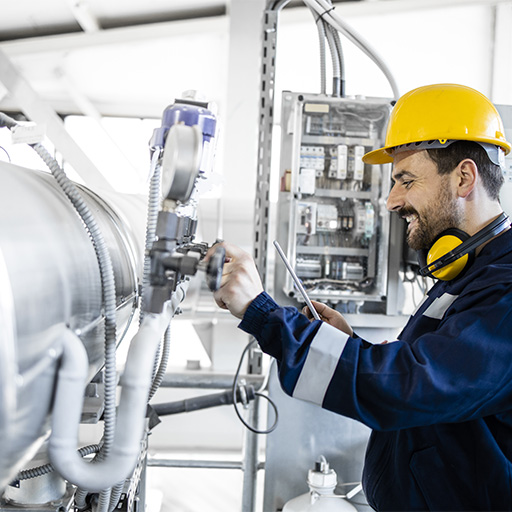
Pumps
The Pumps online training course covers typical applications of various types of pumps. Describes factors affecting pump selection. Explains operating principles of centrifugal, propeller, and turbine, rotary, reciprocating, and metering pumps. Includes special-purpose pumps, diaphragm pumps, and others designed to handle corrosive and abrasive substances. Covers pump maintenance, packing gland, seal, and bearing replacement. This course has no prerequisites. Pumps is available in online technical training and course manual formats.
TPC Training is authorized by IACET to offer 0.7 CEUs for the online version of this program.
Lesson 1 - Pump Development and Application
Topics:
Development of pumps; Pumping systems; Water, chemical, waste, high-viscosity, and solids pumping systems
Learning Objectives:
– Describe dead-end and recirculating hot water distribution systems.
– List several special considerations involved in chemical pumping systems.
– Define the term viscosity and give examples of high-viscosity materials.
– Tell the effects of heat on the pumping of high-viscosity materials.
– List some special problems involved in the pumping of solids.
Lesson 2 - Basic Pump Hydraulics
Topics:
Terminology; Calculating total head, horsepower, and available vs required NPSH; Pump performance; Head capacity; Efficiency; Horsepower curves; Pump selection
Learning Objectives:
– Describe suction head and suction lift pumping conditions.
– Tell what three elements make up total dynamic head.
– Define static suction head.
– Contrast liquid, brake, and electrical horsepower.
– Tell what useful information can be gained from pump curves.
Lesson 3 - End-Suction Centrifugal Pumps
Topics:
Operation; Part definitions; Casing materials; End-suction casing configurations; Impeller types; Wearing rings; Shafts, bearings, and sleeves
Learning Objectives:
– Describe the function of the following: pump casing, shaft, impeller, wearing rings, and stuffing box.
– Contrast frame-mounted and close-coupled end-suction pumps.
– Give characteristics of fluids pumped with open, semi-open, and closed impellers.
– Name an advantage and a disadvantage each for stainless steel and brass shaft sleeves.
Lesson 4 - Propeller and Turbine Pumps
Topics:
Line-shaft, can, and submersible turbines; Flow patterns; Axial- and mixed-flow propeller pumps; Turbine pump construction and applications
Learning Objectives:
– Explain the construction of a line-shaft turbine pump.
– Name the two types of flow possible in a propeller pump.
– Tell the function of diffuser vanes in an axial-flow propeller pump.
– Define electrochemical corrosion and state its cause.
– Describe fluids that can be pumped by a regenerative turbine pump.
Lesson 5 - Rotary Pumps
Topics:
External-gear, internal-gear, lobe, screw, vane, rotary piston, and flexible-member pumps; Rotary pump installation
Learning Objectives:
– Describe the fluids that can be pumped by a rotary pump.
– Explain the operation of external- and internal-gear pumps.
– Describe the parts and construction of a lobe pump.
– Compare and contrast timed and untimed screw pumps.
– Tell why sealed bearings might be used in a vane pump.
Lesson 6 - Reciprocating Pumps
Topics:
Reciprocating pump applications, parts, classification, and operation; Horizontal and vertical plunger pumps; Air-driven pump operation
Learning Objectives:
– Name the parts that make up the power end of a reciprocating pump and describe their operation.
– Define the terms single-acting pump and double-acting pump.
– Compare simplex and duplex pumps.
– Explain how the pumped fluid lubricates a reciprocating pump.
– Calculate the discharge pressure of an air-driven pump when given the piston ration and motor air supply.
Lesson 7 - Metering Pumps
Topics:
Uses and classes of metering pumps; Plunger, piston, diaphragm, air-operated, and rotary metering pumps
Learning Objectives:
– Tell what kinds of pumps are used for metering applications.
– Describe metering pump lubrication techniques.
– Name the parts of a diagram metering pump and state the function of each.
– Explain the operation of a diaphragm metering pump.
Lesson 8 - Special-Purpose Pumps
Topics:
Handling difficult materials; Chemical, magnetic-drive, canned-motor, slurry, pulp-handling, trash, sewage, diaphragm, and vortex pumps
Learning Objectives:
– Describe the operation of a flexible-tube pump.
– Give an application for a progressing-cavity pump.
– Name one disadvantage of a seal-less magnetic-drive pump.
– Explain how to prepare a new centrifugal pump for operation.
– Tell which parts of a reciprocating slurry pump require the most maintenance.
Lesson 9 - Packings and Seals
Topics:
Sealing requirements; Stuffing boxes; Packing materials and recommendations; Installing packing; Mechanical, cartridge, balanced, and special seals
Learning Objectives:
– Tell why slight leakage through shaft seals is necessary.
– Name the type of stuffing box required for pumps operating under suction lift conditions.
– Give a typical application each for cotton, Teflon", and aluminum packing.
– Describe the procedure involved in replacing pump packing.
– Describe a packingless seal.
Lesson 10 - Pump Maintenance
Topics:
Pump bearings, lubrication, and seals; Pump installation and maintenance; Centrifugal, turbine, rotary, and reciprocating pump maintenance
Learning Objectives:
– Name three types of antifriction bearings.
– Name three factors to consider when preparing pump lubrication schedules.
– Describe a typical application for each of the following bearing seals: felt, leather, synthetic.
– Tell the two major maintenance problems encountered in rotary pumps.
– Explain how to identify worn piston rings in a reciprocating pump.